
Tuesday, 28 April 2026
There’s a point in almost every workshop when someone tries to explain what they do in a single sentence, but the words don’t quite come together.
It can happen to me too.
Not because the work isn’t strong, or the idea isn’t valuable, but because clarity is harder than it looks.
Especially in healthcare, innovation and other complex or sensitive industries.
Complexity isn’t the problem. Communication is.
Many sectors rely on technical language, specialist thinking, and detailed processes that are essential to their work.
But what makes sense internally doesn’t always translate externally.
And if people can’t understand your work quickly and clearly, they’re less likely to engage with it, support it, fund it, adopt it or share it.
Clarity isn’t about simplifying the work itself. It’s about making sure the meaning is understood beyond the room it’s created in.
How do you describe your work?
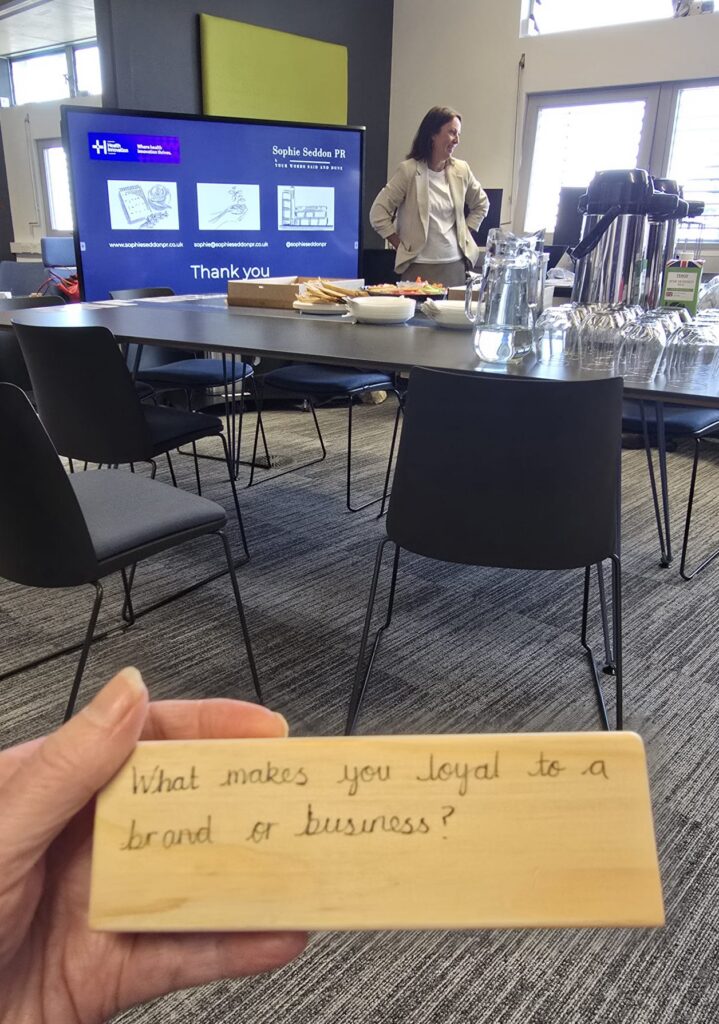
In a ‘Strategic Messaging and Storytelling’ workshop I delivered for Huddersfield Health and Innovation Incubator (HHII) at The Glass Box Huddersfield last week, we worked through how people describe their day-to-day work.
Not to change what they do, but to explore how it lands with different audiences.
We removed jargon, acronyms and assumptions that others wouldn’t automatically understand.
The shift isn’t always in saying less, but in saying it more precisely.
When you say it loud, you hear it differently.
A useful part of the session was hearing people talk about their work out loud, then working together to refine how it could be understood more easily.
Some explanations were already strong. Others just needed small adjustments.
That’s completely normal.
Messaging isn’t fixed. It develops over time as ideas evolve and as audiences change.
We just need to close the gap between what we mean and what others hear.
Storytelling in complex industries
We also explored storytelling not just as marketing, but as communication.
A way to help people move away from purely technical descriptions and into something more accessible, without losing accuracy, detail or professionalism.
Because clarity should never dilute expertise. It should make it relatable and usable.